
Written By: Dave Manuel
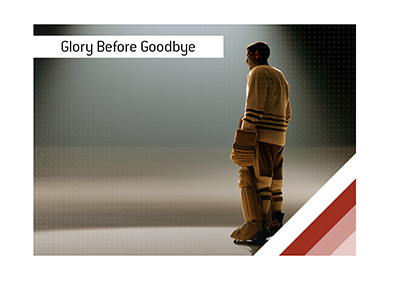 Modern athletes get traded for failing to play through a sore knee. In 1934, the captain of the Chicago Black Hawks won his team its first Stanley Cup while a tonsillar infection silently destroyed his kidneys. He stopped 40 shots in a double-overtime shutout to clinch the Cup. He was named first star. He rode through downtown Chicago in a wheelbarrow, pushed by a teammate, on the day of the parade. He had eight weeks to live. The story of Charlie Gardiner is one of the strangest, saddest, and most accidentally heroic chapters in the history of professional sports, and almost nobody under the age of 60 has heard it.
Smiling Charlie Gardiner: The Goalie Who Won The Stanley Cup, Then Died From The Season He Just Won
In April 1934, Chicago's captain played 90 minutes of scoreless playoff hockey with a fever, kidney pain, and an infection that was already killing him. Two months later, after a singing lesson in Winnipeg, he collapsed. He never woke up.
Modern athletes get traded for failing to play through a sore knee. In 1934, the captain of the Chicago Black Hawks won his team its first Stanley Cup while a tonsillar infection silently destroyed his kidneys. He stopped 40 shots in a double-overtime shutout to clinch the Cup. He was named first star. He rode through downtown Chicago in a wheelbarrow, pushed by a teammate, on the day of the parade. He had eight weeks to live. The story of Charlie Gardiner is one of the strangest, saddest, and most accidentally heroic chapters in the history of professional sports, and almost nobody under the age of 60 has heard it.
The Goalie Nobody Wanted To Sell
Charles Robert Gardiner was born in Edinburgh, Scotland, on December 31, 1904, and emigrated with his family to Winnipeg at age seven. He didn't put on skates until eight. Because he couldn't keep up with the better skaters, the older boys made him stand in goal. The position stuck. By 21 he was playing senior hockey for the Selkirk Fishermen of Manitoba. By 22 he was a professional goaltender for the Winnipeg Maroons. In November 1927 he signed with the NHL's Chicago Black Hawks.
He was, by any measure, one of the best goalies in the world. Two Vezina Trophies (the award for the goalkeeper allowing the fewest goals over a season). Three First All-Star Team selections, plus a Second-Team nod. A career goals-against average of 2.02 over 316 games. He was nicknamed "Smiling Charlie" because he chatted with opposing forwards in front of his crease and grinned through 60-minute shifts. The Montreal Star later called him "the supreme showman of the sport, the grinning curly-head who was both a successful clown and the game's greatest goaltender."
In February 1929, Chicago played a forgettable game against the New York Rangers. Maroons manager W.J. Holmes was in attendance. Black Hawks owner Frederic McLaughlin offered to sell him Gardiner for $3,500. McLaughlin had grown frustrated with his goaltender's win-loss record on a team that scored almost no goals. The deal was within hours of being signed when assistant coaches Barney Stanley and Hugh Lehman talked McLaughlin out of it. Five years later, the goalie nobody wanted to sell was carrying a fundamentally limited Chicago team toward its first Stanley Cup.
The Infection That Wouldn't Stop
Gardiner's tonsil infection began during the 1932-33 season. He kept it private at first. He went public on December 23, 1932 and played the next night anyway in Toronto, making 55 saves in a Black Hawks win. Frank Calder, the NHL president, and Toronto's Charlie Conacher both publicly praised his performance. After the game Gardiner collapsed on the dressing room floor.
In an era before antibiotics, a tonsillar infection that would not resolve was a death sentence in slow motion. The bacteria spread from his throat into his bloodstream and from there into his kidneys. By January 1934, on a train back to Chicago after a road trip, the pain had spread throughout his body. He told coach Tommy Gorman it was a minor headache. He woke the next morning unable to see; black spots covered his vision. The medical term for what was happening to him was uremic convulsion - his kidneys were failing, allowing toxins to build up in his blood, and the toxins were attacking his brain. He would have one of these episodes per month for the rest of his life. He kept playing.
On March 29, 1934, in a playoff game against the Montreal Maroons, Gardiner posted a 3-0 shutout. He had a fever of 102 degrees Fahrenheit during the game. A doctor attended to him in the dressing room between periods. He was named first star anyway. Teammates later described seeing him slumped over the crossbar during stoppages, nearly blacking out, then snapping back to ready position when the puck came up the ice. Eyewitness accounts say he refused all suggestions to have the tonsils surgically removed because the recovery would have cost him games.
The Stanley Cup Final, In One Game
Chicago and Detroit met in the 1934 Stanley Cup Final, a best-of-five series. The Black Hawks won the first two games on the road in Detroit, 2-1 and 4-1. Detroit took Game 3 in Chicago, 5-2. Game 4 was played April 10, 1934 at Chicago Stadium. It went to double overtime, scoreless. Gardiner played all 90 minutes plus overtime. He stopped every shot Detroit fired at him: 40 of them. Wilf Cude, the Detroit goalie, stopped 52 of 53 the other way. At the 10:05 mark of the second overtime, Chicago's 140-pound winger Harold "Mush" March put the puck behind Cude. Chicago won 1-0. Their first Stanley Cup. Gardiner had a 1.33 goals-against average across the entire 1934 playoffs.
It was the first Stanley Cup-winning overtime goal in the history of the National Hockey League. Frank Calder, the league president, presented the trophy on the ice to Charlie Gardiner, the captain. The captaincy was itself a record: Gardiner remains, 92 years later, the only goaltender in NHL history to captain his team to a Stanley Cup victory. The rules were later changed to prevent goalies from holding the position.
A Wheelbarrow Down State Street
Before the playoffs began, Black Hawks defenseman Roger Jenkins, a 22-year-old from Appleton, Wisconsin, had been talking with his blueline partner Art Coulter about how nice it would be just to qualify for the postseason. Gardiner, strapping on his pads in the dressing room nearby, overheard. He told Jenkins that if Chicago won the entire thing, Jenkins would have to push him through the streets of downtown Chicago in a wheelbarrow. The bet was made. The Black Hawks won the Cup. On the day of the parade, Roger Jenkins put Charlie Gardiner in a wheelbarrow and pushed him through Chicago's business district in front of cheering crowds. It was the last good belly laugh of his life.
Eight weeks later, on June 10, 1934, Gardiner left a singing lesson in his hometown of Winnipeg. He was a baritone; music was his offseason hobby alongside flying lessons. As he walked out the door of the studio, he collapsed. He was rushed to St. Boniface Hospital. He never woke up. On June 13, 1934, three days after the collapse, the brain hemorrhage caused by the bacterial infection in his tonsils ended his life. He was 29 years old. The Winnipeg Tribune ran the headline the next day: "Chuck Gardiner, world's best goalie, is dead."
An Era That Killed Its Stars
Gardiner's death was not an isolated incident. The 1930s NHL operated in a medical vacuum that modern fans cannot imagine. Goalies played without masks. Skaters played without helmets. Antibiotics did not become widely available until the 1940s. Eddie Shore's 1933 hit ended Ace Bailey's career and very nearly his life. Lorne Chabot, another All-Star goalie of the same era and Gardiner's eventual successor in the Chicago net, would suffer Bright's Disease (chronic kidney inflammation) and die at 46. Howie Morenz, the league's biggest superstar and a contemporary, died in March 1937 at age 34 from complications of a leg broken in four places during a January game. The same generation of players that built professional hockey in North America also paid for it in lives.
The Run, From Symptom To Statue
The Honors He Could Not Receive
In 1945, when the Hockey Hall of Fame was established, Gardiner was named one of the inaugural inductees, posthumously. In 1998, The Hockey News ranked him the 76th-greatest hockey player of all time and the 15th-greatest goaltender in league history. He is a member of Canada's Sports Hall of Fame, the Manitoba Hockey Hall of Fame, and the Manitoba Sports Hall of Fame and Museum. Roger Jenkins, the defenseman who pushed the wheelbarrow, would play eight more NHL seasons. Mush March, who scored the Cup-winner, played 17 seasons total, all with Chicago, and lived until 2002. Frank Calder, the NHL president who handed the Cup to a dying captain, has the trophy for NHL Rookie of the Year named after him.
For years after Gardiner's death, the Black Hawks left the captaincy formally vacant as a tribute. By some accounts the team did not officially name a new captain until Johnny Gottselig in 1935-36, and even then, contemporary newspaper accounts of Gottselig's appointment are difficult to find. The 1942 Owen Sound Sun-Times reported that Mush March had been offered the captaincy in 1934 but turned it down, both out of deference to Gardiner and out of a superstition that every Black Hawks captain prior to Gardiner had been sold, traded, or fired. The 1934 Stanley Cup itself was, anomalously, accepted on the ice not by a player but by the team's owner, Major Frederic McLaughlin - perhaps because Gardiner, the official captain, was visibly too sick to skate it around.
What Gets Lost When Sports Gets Safer
It is impossible to imagine a modern NHL goaltender doing what Charlie Gardiner did. The injury-disclosure standards alone, never mind the league's medical staff, the players' union, or the Concussion Protocol, would have pulled him off the ice in December 1932 and not allowed him back until the infection was resolved. He would have had his tonsils removed in January 1933. He would have missed maybe ten games. He would probably still be alive today, or at least, he would have lived a normal life and died a normal death of old age in the 1980s or 1990s. He would not have a Stanley Cup as a captain. He would not have died at 29.
Sports stories like Gardiner's get harder to tell honestly because the modern reader instinctively wants to know whose fault it was that he died. The answer is not one person. The answer is an era. Antibiotics, helmets, masks, neutral team doctors, mandatory injury disclosure, and the entire 90-year apparatus of player safety did not exist in 1934, and Charlie Gardiner played in the world that did exist. He was 29. He had won the biggest trophy in his sport less than two months before he died. He had ridden through Chicago in a wheelbarrow as a joke. He was a baritone who had just left a singing lesson when his body finally gave out.
Modern hockey is safer, more profitable, and more analytically advanced than the 1934 NHL by almost every measure. There is no version of the modern game that produces a Charlie Gardiner story, and that is a good thing. But the cost of safety is the disappearance of a certain kind of hero, the kind who plays through what cannot be played through, and the cost of that disappearance is that almost nobody remembers the names. Smiling Charlie Gardiner. Roger Jenkins and his wheelbarrow. Mush March and his second-overtime slap shot. The 1934 Chicago Black Hawks. They are all there in the record book. The story of how they won deserves to travel.
SOURCES & REFERENCES
- Wikipedia, "Charlie Gardiner (ice hockey)" and "1934 Stanley Cup Final."
- The Hockey News, "Top 100 Goalies: No. 15 - Charlie Gardiner," November 10, 2018.
- NHL.com / Chicago Blackhawks, "On This Day: Chicago's First Stanley Cup."
- NHL.com, "Stanley Cup Annual Record 1934."
- Canadian History Ehx (canadaehx.com), "Charlie Gardiner," October 2, 2024.
- Manitoba Historical Society, "Memorable Manitobans: Charles Robert 'Charlie' Gardiner (1904-1934)."
- Winnipeg Tribune, "Chuck Gardiner, world's best goalie, is dead," June 14, 1934, page 1.
- Montreal Gazette, June 14, 1934 (Jack Adams obituary tribute).
- NHL History Substack (nhlhistory.substack.com), "Remembering Charlie Gardiner (Part Two)," August 16, 2024.
- Puckstruck (puckstruck.com), Stephen Smith, multiple Charlie Gardiner posts.
- Chicago Public Library, "1934 Chicago Blackhawks Stanley Cup Champions," November 16, 2013.
- Hockey-Reference.com, 1933-34 Chicago Black Hawks season records.
- Wikipedia, "Howie Morenz" and "Lorne Chabot" (era context).
- The Canadian Encyclopedia, "Howie Morenz."
- Bleacher Report, "Defining Chicago Black Hawk History: Charlie Gardiner."