182 Points and Gone: The Year the Soo Invented 99
Published on July 14th, 2026 10:00 am ESTWritten By: Dave Manuel
 Wayne Gretzky spent exactly one season with the Sault Ste. Marie Greyhounds, and it contains the entire origin story: drafted third overall on June 6, 1977 after two teams passed and his father warned the Soo in writing that he would not report, signed on August 16 after a tuition guarantee and a famous winter coat, handed 19 and then 14 before two nines were suggested because Brian Gualazzi would not give up the 9, and finally 70 goals, 112 assists and 182 points in 64 games at age 16 - still the franchise record - plus 26 points in 13 playoff games. He left at 17 for the WHA's Indianapolis Racers because the NHL would not touch a player under 20. The full file: the draft, the standoff, the stats, the number, and the getaway. Current to July 14, 2026.
Sports-King Feature
One Winter in the Soo
Wayne Gretzky was drafted by a team his father had warned in writing, wore three numbers before inventing the most famous one in sports, scored 182 points as the youngest player in the league, and was gone inside a year. The complete file on the season that built 99.
3RDOverall · 1977182Points · Age 1699Born Here · 1977
On June 6, 1977, thirteen Ontario junior teams gathered to draft 230 midget-aged players, and the two clubs picking first both passed on the most famous 16-year-old in hockey. Oshawa took Tom McCarthy. Niagara Falls took Steve Peters. And with the third pick, the Sault Ste. Marie Greyhounds - a struggling franchise in a remote northern city, 700 kilometers from Brantford - selected Wayne Gretzky, in open defiance of a written warning from his father that the boy would never report. What followed was one of the strangest and most consequential single seasons in hockey history: a negotiation won with a university-tuition promise and a winter coat, a jersey number invented because his idol's 9 was taken, a 5-foot-8, 155-pound teenager finishing second in the scoring race to a 20-year-old, a mid-season coaching change that soured everything, and an escape hatch marked WHA that closed the junior chapter after exactly one year. Everything the world later called The Great One was assembled in the Soo, in a single winter, mostly against the family's wishes. This is the whole story - the draft, the standoff, the stats, and the getaway.
Drafted3rd
Points, Age 16182
Numbers Worn19, 14, 99
Seasons1
1
The draft that two teams flinched from
The DraftOMJHL Midget, 1977
Pick 1Tom McCarthy, Oshawa
Pick 2Steve Peters, Niagara Falls
Pick 3Gretzky, the Soo
The WarningIn writing, from Walter
The Distance700 km from home
The signature: the greatest player who ever lived went third in his own junior draft - to the one team his family had explicitly told not to bother
By 1977 Wayne Gretzky was already the most publicized child athlete in Canada - 378 goals in a single novice season at age 10, then a Junior B apprenticeship against players years older, and even a three-game emergency cameo with the Peterborough Petes at 15 that produced three assists. None of it made him the first pick. Walter Gretzky had told the Ontario teams, in writing, that his son would not move to Sault Ste. Marie, a northern outpost whose junior team endured the league's most brutal travel; the family expected Wayne to land in Peterborough, close to Brantford. Oshawa took Tom McCarthy first. Niagara Falls took Steve Peters second. And Greyhounds general manager Angelo Bumbacco, holding the third pick for a team that had just finished third-last, decided a written refusal was a negotiating position rather than a fact, and called the name anyway. It remains one of the great calculated risks in junior hockey history: the two clubs that flinched are trivia answers, and the one that gambled owns the origin story of 99.
2
From written refusal to signed contract in 71 days
The ObjectionsDistance, travel, school
The FixerAngelo Bumbacco
The Promise4 years of tuition
The LandingA family they knew
SignedAug 16, 1977
The ClincherA winter coat
The signature: the deal that delivered the Great One to junior hockey was sealed with a university guarantee and a jacket for the northern cold
The standoff lasted most of the summer, and Bumbacco won it the way small-market lifers do: patiently, personally, and with terms nobody else had thought to offer. He worked on Walter directly, and the package that turned the family was practical rather than glamorous - a guarantee of four years of tuition at any North American university if Wayne was ever cut or injured, and a billet arrangement with a family the Gretzkys already knew, which solved the loneliness problem that 700 kilometers had created. Wayne signed on August 16, 1977. The detail that sealed the relationship came later, and it is the most Bumbacco story of all: on a cold August day, when the 16-year-old admitted he owned no warm jacket for the winter ahead, the general manager simply went out and bought him a coat. Gretzky would say the city ended up reminding him of Brantford. The travel his father feared was real - the Soo's road trips were the league's worst - but the kid the town got in exchange doubled attendance at Memorial Gardens by himself and put a struggling franchise on Hockey Night in Canada.
3
The accidental invention of 99
He Wanted9, for Gordie Howe
But 9 WasBrian Gualazzi's
ExhibitionHe wore 19
Opening NightHe wore 14
The SuggestionTwo nines
The PrecedentEsposito's 77
The signature: the most famous number in sports exists because a teammate in Sault Ste. Marie would not give up his sweater
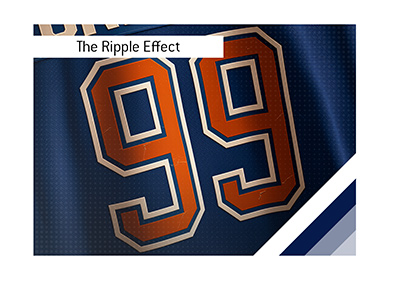
The most valuable piece of intellectual property in hockey was improvised in the Soo dressing room inside a month. Gretzky arrived wanting 9, the number of his idol Gordie Howe, and ran into the most consequential jersey squatter in sports history: teammate Brian Gualazzi, who already wore it and kept it. So Gretzky wore 19 through the exhibition schedule, then 14 on opening night - a night he marked with a hat trick and three assists, his first junior goal a backhand 4 minutes and 43 seconds into the season. A few games in came the suggestion that changed the sport's iconography: if one 9 was taken, wear two - the same logic Phil Esposito had just applied in New York, doubling his taken 7 into 77. Accounts differ on exactly who said it first, with most crediting coach Muzz MacPherson and some the front office, but everyone agrees on the date of birth: 99 first appeared on a hockey sweater in Sault Ste. Marie in the fall of 1977, on the back of a 16-year-old, as a workaround. Twenty-three years later the NHL retired it league-wide. Gualazzi kept his 9 all the way to a law practice, presumably at peace with his role in history.
4
The stat line, age 16
Games64
Goals70
Assists112
Points182
League Rank2nd, behind Smith's 192
Still TodayOHL rookie records
The signature: the only players ever to out-point teenage Gretzky over a junior season needed to be four years older to do it
The season itself was a sustained impossibility. Gretzky opened his OMJHL career on a 23-game point streak, piled up points at 2.84 per game, and finished with 70 goals and 112 assists for 182 - numbers that remain, five decades later, the Greyhounds' single-season franchise record. He was the youngest regular in a league of men up to four years older, at 5-foot-8 and 155 pounds, and the only player who beat him was exactly that: 20-year-old Bobby Smith of Ottawa, in his fourth and final junior season, won the scoring title 192 to 182. The league gave Gretzky the Emms Family Award as rookie of the year and the William Hanley Trophy as its most sportsmanlike player; the hockey world gave him something bigger, when the 1978 World Juniors in Montreal turned the 16-year-old into the tournament's leading scorer with 17 points in 6 games against the planet's best under-20s. Arenas sold out across Ontario to see him, media requests grew so relentless he once asked a reporter to buy him breakfast in exchange, and the team around him - which endured a 12-game losing streak despite all of it - could never quite keep up. In the playoffs he somehow raised the degree of difficulty and still produced: 26 points in 13 games, six goals and 20 assists, two points a night in the spring of his 17th birthday. And the season has aged even better than the legend: nearly fifty years later, the 182 points and 112 assists STILL stand as OHL rookie single-season records, the 70 goals rank second all-time among the league's rookies, the 182 remains the second-highest point total in any OHL season ever played - behind only Smith's 192 from the very same winter - and the league named him to its Second All-Star Team on the way out. This May, the CHL ranked him No. 3 on its Top 50 Players of the Last 50 Years, one spot ahead of Connor McDavid; the Greyhounds, who made him the centre on their All-Time Team back in 1999, put out the announcement themselves.
5
The getaway, June 12, 1978
The ProblemNHL age limit: 20
The WaitDraft class of 1981
The LoopholeThe WHA had none
The BuyerNelson Skalbania
The DealPersonal services
SignedOn a private jet
The signature: the NHL's own rulebook handed the best prospect alive to the rival league - and junior hockey never got him back
The departure was written into the calendar before the season even ended, because the NHL's rules made staying pointless. The league did not permit players under 20, which meant the best 17-year-old on earth faced THREE more junior winters before the 1981 draft could touch him - and by midwinter, everything in the Soo was pushing the other way. Muzz MacPherson, the coach who had suggested the two nines, was replaced mid-season by Paul Theriault, who cut Gretzky's ice time by a reported ten minutes a game and wanted his style reshaped; Gretzky was open about his unhappiness, asked about a trade closer to Brantford, floated returning to Junior B, and even mused at the World Juniors about playing professionally in Sweden - and the league nixed every exit. Except one, which was not the league's to close. The World Hockey Association, at war with the NHL and dying for attention, had no age minimum, and on June 12, 1978, Indianapolis Racers owner Nelson Skalbania signed the 17-year-old to a personal services contract famously negotiated aboard his private jet, reported at $1.75 million over seven years. The Racers lasted eight games as his employer before Skalbania, hemorrhaging money, sold him to Edmonton and a man named Peter Pocklington - whose family's own strange place in hockey history we have covered separately. One year after a written refusal, the Soo's gamble was over: 64 games, 182 points, one number invented, and gone.
The Complete Ledger
Every game Wayne Gretzky played in and around the OMJHL, per the standard record - including the Peterborough cameo nobody remembers and the World Junior detour that announced him to the planet. The gold row is the season this article exists for.
| Season | Team | Context | GP | G | A | PTS |
|---|---|---|---|---|---|---|
| 1976-77 | Peterborough Petes (OMJHL) | Emergency call-up, age 15 | 3 | 0 | 3 | 3 |
| 1977-78 | Soo Greyhounds (OMJHL) | Regular season, age 16-17 | 64 | 70 | 112 | 182 |
| 1977-78 | Soo Greyhounds (OMJHL) | Playoffs, age 17 | 13 | 6 | 20 | 26 |
| Dec-Jan 1978 | Canada (World Juniors) | Tournament top scorer, age 16 | 6 | 8 | 9 | 17 |
The Year, Dated
Twelve months, start to finish - from the pick his father forbade to the jet that ended junior hockey's claim on him.
| Date | What Happened |
|---|---|
| Jun 6, 1977 | Drafted 3rd overall by the Greyhounds at the OMJHL Midget Draft, after Oshawa and Niagara Falls pass |
| Summer 1977 | The standoff: Walter's written warning stands until Bumbacco's tuition guarantee and a billet with a family the Gretzkys knew |
| Aug 16, 1977 | Gretzky signs with the Soo Greyhounds |
| Fall 1977 | Wears 19 in exhibition, 14 on opening night - hat trick plus three assists in a 6-1 win over Oshawa, first goal at 4:43 |
| Fall 1977 | The two-nines suggestion lands; 99 appears on a hockey jersey for the first time |
| Dec 1977 | A 23-game season-opening point streak has already made him the league's main attraction; Soo attendance doubles |
| Dec-Jan 1978 | World Juniors, Montreal: leads the tournament in scoring at 16, with 17 points in 6 games |
| Midseason 1978 | MacPherson is replaced by Paul Theriault; Gretzky's ice time drops and his patience with junior hockey goes with it |
| Spring 1978 | Finishes 2nd in scoring, 182 to Bobby Smith's 192; rookie of the year; 26 points in 13 playoff games |
| Jun 12, 1978 | Signs the Skalbania personal services deal with the WHA's Indianapolis Racers, age 17 - junior career over |
The Splits
No complete game-by-game log of the 1977-78 season survives in public records - the OHL did not keep digital game data for another two decades, and the full 64-game ledger lives only in the Sault Star's microfilm. But the documented record supports an honest per-game breakdown, because one number was tracked in real time all winter: the 23-game point streak Gretzky opened his junior career with, worth 75 points. Everything below is derived from that streak and the official season totals, and labeled accordingly.
| Stretch | Context | GP | PTS | PTS/Game |
|---|---|---|---|---|
| Games 1-23 | The opening point streak | 23 | 75 | 3.26 |
| Games 24-64 | The rest of the season | 41 | 107 | 2.61 |
| Playoffs | All 13 postseason games | 13 | 26 | 2.00 |
The documented nights fill in the texture the log cannot. Opening night alone is fully preserved: first junior goal at 4:43 of the first period, a backhand over Oshawa's Georges Gagnon; the hat trick complete 6:37 into the second; three assists on top of it in a 6-1 win - a six-point debut at sixteen. The streak that followed means he averaged better than three points a game for the season's first two months while the whole league adjusted arenas and expectations around him, and the 2.61 he 'settled' into afterward would still have led most teams in the league by itself.
The Arithmetic
Three bar charts that carry the season's weight. The scoring race he lost to a grown man, the age-16 comparison with the only rival his legend ever had, and the pace he kept when the games got heavier.
The 1977-78 scoring race
Bobby Smith would go first overall in the 1978 NHL draft and enjoy a fine career of just over 1,000 NHL points. The 16-year-old he held off finished with 2,857.
Sixteen-year-old seasons, the only comparison that matters
Lemieux's fabled 282-point junior season came at 18. At 16, in his own first full year, Mario scored 96 - to Gretzky's 182 in a league widely considered less generous to scorers.
Points per game: season vs playoffs
The playoff dip from 2.84 to an even 2.00 per game is the only statistical evidence all season that Wayne Gretzky was, in fact, sixteen.
The Record Book
The margins of the file: the trivia the draft created, the man who kept his number, the aftershave, and where the story went next.
The Two Who PassedTom McCarthy and Steve Peters did nothing wrong except get picked before history. McCarthy was a genuinely elite junior who became a first-round NHL pick and a two-time 35-goal scorer for Minnesota; Peters played a handful of NHL games for Colorado. Neither Oshawa nor Niagara Falls was foolish - both believed the written warning that Gretzky would never report to a distant team, and Oshawa and Niagara Falls were far enough from Brantford to take it seriously. The Greyhounds were even farther away, and drafted him anyway. The lesson survives in every draft room in hockey: the risk is not taking the wrong player. It is believing the reasons not to take the right one.
The Man Who Kept NineBrian Gualazzi, Sault Ste. Marie born and raised, was a fine junior scorer and is the answer to the best trivia question in hockey: who owned the 9 that forced the 99. He never surrendered the number, finished his junior career a Greyhound, and went on to a long career as a Crown attorney. The two-nines suggestion itself comes with a small source dispute this article declines to launder: most accounts credit coach Muzz MacPherson, some the front office, and all agree on the Esposito precedent - Espo had just doubled his taken 7 into 77 with the Rangers, and the Soo simply applied the math to a 9.
The AftershaveThe season's best time capsule: after his opening-night hat trick, the 16-year-old was named the media's player of the game and handed the sponsor's prize - a bottle of Brut aftershave. The whiskerless winner's reported response: what am I supposed to do with aftershave lotion? Attendance at Memorial Gardens doubled that season, the New York Times and Hockey Night in Canada came north, and the kid asked a reporter to buy him breakfast in exchange for an interview. The fame arrived fully formed; the beard took years.
Where the Story WentThe Racers lasted eight games as Gretzky's employer before Nelson Skalbania, out of money, sold him to Edmonton - to Peter Pocklington, whose family's own bizarre corner of hockey history (sixteen X's on the Stanley Cup) we have told separately. When the WHA merged into the NHL a year later, the Oilers kept him as a priority selection, and the rest is forty record books. The Greyhounds, for their part, kept the franchise scoring record he set at 16, added Hall of Famers named Coffey, Francis and Thornton to their alumni wall, and remain the answer to the question this article opened with: the team that heard no, and drafted him anyway. We first wrote about this season years ago in a shorter piece; consider this the full file.
Sports-King's Note
Now for the fine print. The statistical record follows the standard chronology: 64 games, 70 goals, 112 assists and 182 points in the 1977-78 OMJHL regular season, with 6 goals and 20 assists for 26 points in 13 playoff games, plus the 3-assist Peterborough cameo of 1976-77 and the 17-point World Junior tournament - a small number of secondary sources list 62 or 63 regular-season games, and we have gone with the count used by the league's and the player's own canonical records. The two-nines suggestion carries a genuine source split (coach MacPherson in most tellings, the front office in others) that we disclose rather than resolve. The Skalbania contract figure is reported rather than documented ($1.75 million over seven years is the standard account), and the ten-minute ice-time reduction under Theriault is as contemporaneously reported. The tuition-guarantee and winter-coat details are from the Sault's own local histories of the season. The per-game splits table is DERIVED, not archival: no public game-by-game log of the season exists (the complete record survives only in newspaper microfilm), so the three stretches are computed from the documented 23-game, 75-point opening streak and the official totals - simple subtraction, disclosed as such. The standing OHL rookie records, all-time season ranking, Second All-Star Team selection and the May 2026 CHL Top 50 ranking (No. 3, ahead of McDavid) are from the CHL and Greyhounds' own announcements. One housekeeping note: this article supersedes and expands our short early piece on the same season, which remains live and now points here.One Last Word
Every legend gets an origin myth, and most get polished in the retelling. What makes the Soo winter remarkable is that it needs no polish: the facts already read like fable. A father's written refusal. A general manager who bought a boy a coat. A teammate who would not give up a number, and the improvisation that became the most famous integer in sport. A scoring race lost honorably to a man four years grown, and a rulebook so blind it pushed its greatest asset out the door at 17.
Sault Ste. Marie had Wayne Gretzky for sixty-four games plus thirteen more in the spring, and it turned out to be exactly enough: enough to invent the number, set a record that has survived half a century of Greyhounds, and prove that the family's fears and the team's gamble could both be right at once. The city that was too far from home is now permanently attached to the name. Some investments are measured in seasons. The Soo's was measured in nines.