How the MLB Luxury Tax Actually Works: Thresholds, Surcharges and the Cohen Tax
Published on September 16th, 2026Written By: Dave Manuel
Every December, the week before Christmas, Major League Baseball mails out the strangest bills in professional sports: assessments for the Competitive Balance Tax, the mechanism everyone calls the luxury tax and nobody fully understands. The bills have been sent every year since 2003, they have totaled more than $1.63 billion, and they have gone to exactly fifteen franchises - while fifteen others have never received one. This file opens the whole drawer: the first receipt ever written, the brackets and surcharges that price a payroll, the teams that duck under the line by amounts smaller than a used car, the tax named after one specific owner, the record $169 million bill attached to a World Series parade, and the December 2026 deadline that will decide what this system becomes.
Baseball’s first luxury tax was a strange, elegant machine. From 1997 through 1999 the sport taxed every dollar spent above a floating line - the midpoint of the fifth and sixth highest payrolls - at 35 percent, which meant the tax was designed to always catch the top five spenders no matter what they spent. No fixed threshold, no escalators, no surcharges: just a moving target that followed the market up.
It lasted three seasons and vanished; from 2000 through 2002 there was no luxury tax at all, and payrolls did what payrolls do. But the prototype established the concept the union could live with and the owners could build on: not a cap, a price. Everything that follows in this file - every bracket, every reset, every nine-figure December bill - descends from that three-year experiment.
The tax as we know it was born on August 30, 2002, in a deal reached hours before the players walked out - the agreement that avoided a strike and rebranded the luxury tax as the Competitive Balance Tax, with a fixed threshold at last: $117 million for 2003. The rates were almost apologetic - 17.5 percent for a first offense - and the first assessment caught exactly one team.
The New York Yankees were billed $11,798,357 for the 2003 season, the first receipt in the drawer this article is named for. It reads quaintly now: the 2025 Dodgers pay more than that in tax roughly every two weeks of the season. But every ledger starts with a first entry, and baseball’s starts here - one team, one line, eight digits, and a habit the sport has never broken since.
For its first decade and a half, the Competitive Balance Tax had one reliable customer. The Yankees paid it every single season from 2003 through 2017 - fifteen consecutive bills, through dynasty hangovers and rebuilds alike - peaking at $34.1 million after the 2005 season, a figure that stood among the largest ever written for a decade. By the end of 2016 their running tab had reached $325 million; through 2017, New York alone accounted for roughly 60 percent of every dollar the tax had ever collected.
Boston wandered over the line now and then. Detroit and San Francisco made cameos. But the honest name for the mechanism during its first two decades was the Yankee tax - a bespoke penalty for one franchise’s appetite, which is precisely what its architects intended and precisely why the sport eventually needed bigger paperwork.
The second franchise to make the tax a lifestyle arrived from the west. The Guggenheim-era Dodgers ran the sport’s biggest payrolls through the mid-2010s and after the 2015 season were handed the largest bill ever written: $43.6 million, on a CBT payroll of $297.9 million. Sportswriters reached for the smelling salts. That record would stand for eight years - and then be exceeded eight separate times in three.
The 2016 assessments marked the other turning point: a record six teams paid at once - the Dodgers, Yankees, Red Sox, Tigers, Giants and the World Series champion Cubs - the first December in which the tax read like a league-wide instrument rather than one franchise’s recurring subscription. The receipts were multiplying. The sport barely noticed what it was practicing for.
The tax’s most consequential clause is the quietest one: dip below the threshold for a single season and your escalators reset to the first-timer rate. The Yankees pioneered the maneuver in 2018, ending their fifteen-year streak on purpose. Toronto ran the modern masterclass - by trimming under the line in 2024, the Blue Jays reset their status and saved roughly $21 million on their 2025 bill, which would otherwise have run to almost $34.65 million.
And then there is the scalpel work. In 2023 the Angels shed salary late and finished below the threshold by $28,654 - about eight days of one minimum salary - a margin that upgraded their compensation pick for losing Shohei Ohtani by roughly seventy draft slots. This is the entry that answers the eternal argument: a tax teams re-engineer entire seasons to duck, by margins measured in lunch money, is functioning as a cap in everything but name.
The 2022 CBA emerged from a 99-day lockout carrying a new weapon: a fourth tax threshold, set $60 million above the first, with rates so punitive that everyone understood the target immediately. Officially it is the fourth surcharge tier. Universally it is the Cohen Tax, written into the agreement specifically to slow the new Mets owner whose checkbook had terrified his 29 partners - and for repeat offenders, every dollar spent above it costs $2.10.
The ladders deserve printing in full, because they are the article’s machinery: a first-time payer climbs 20, 32, 62.5 and 80 percent through the four tiers; a third-year offender climbs 50, 62, 95 and 110. Steve Cohen’s response to the tax bearing his name was to blow through it repeatedly - $320.3 million in bills across the last four seasons - which tells you most of what the next entry needs you to know.
The 2023 Mets did what no franchise had ever done: they were billed nine figures for a single season - $100.8 million in tax on a record $374.4 million CBT payroll - and they did it while missing the playoffs entirely, selling off Max Scherzer and Justin Verlander at the deadline in a fire sale that trimmed $8.4 million off the tax bill of a season already lost. The receipt outlived the roster it paid for.
The league-wide arithmetic broke the same December. Eight teams paid a combined $209.8 million - nearly triple the previous full-league record of $75.8 million, set only the year before. The era of the tax as rounding error was over; from here forward, the December assessments read like a second free agency, and the record book this article keeps required a new column.
Twelve months later the crown moved west and the field filled in. The Dodgers took the single-season record from the Mets at $103,016,896, a record nine teams paid at once, and the league-wide total reached $311.3 million - each figure a fresh entry for the record book, each one about to last exactly one year. At the other end of the table sat the season’s most charming line item: the Cubs, over the line by a hair, billed $570,309 - the tax equivalent of a parking ticket filed between hundred-million-dollar assessments.
The Dodgers’ receipt came with a flag attached: they won the World Series, then paid the bill, and nobody in Los Angeles considered the sequence anything but correct. The deterrent had completed its quiet transformation into a line item on the cost of a parade - which is the entire thesis of the entry that follows.
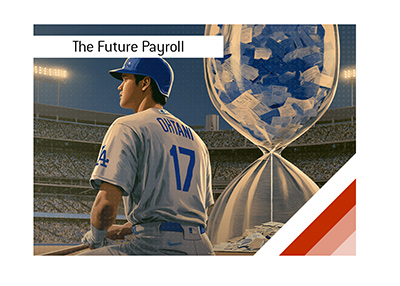
Then came the receipt this article is named for. The 2025 Dodgers ran a CBT payroll of $417,341,608 - the most expensive roster ever assembled - and in December were assessed $169,375,768 in tax: a bill larger than the entire payrolls of twelve major league teams, larger than the combined bills of every other payer except the Mets, and attached, once again, to a World Series champion, the second in a row. Their two-year tax total alone reached $272.4 million. As a fifth-year repeat offender over all four tiers, they climbed the full ladder: 50 percent, 62, 95, and 110 on everything past the Cohen line.
Around them: the Mets at $91.6 million, the Yankees at $61.8 million, the Phillies at $56.1 million, Toronto’s $13.6 million, San Diego’s $7 million, and Boston, Texas and Houston combining for barely $3.2 million more - nine payers, $402.6 million, every total a record. The five biggest spenders also surrendered draft position, their top picks dropped for crossing the third tier. The bills came due January 21. They were paid without comment.
Two ledger truths before the finale. First: since 2003, more than $1.63 billion in tax has been assessed - to just fifteen franchises. The other fifteen have never paid a cent. Half of Major League Baseball has literally never encountered its own competitive balance tax, and the gap the tax was meant to police remains a canyon: Miami’s 2025 CBT payroll of $86.9 million was roughly one-fifth of the Dodgers’ figure.
Second, the question every fan answers wrong: where does the money go? Article XXIII(H) of the CBA runs the trail. The first $3.5 million of each year’s collections funds player benefits. Of the remainder, half funds player retirement accounts, and half flows into MLB’s revenue-sharing distributions to clubs. It is not a check mailed to Pittsburgh with the Dodgers’ return address; the players get half the pot back, and the club half moves through the sport’s regular redistribution machinery. The tax redistributes less than its reputation suggests - it deters, it prices, and it funds pensions.
Every receipt in this file is now an exhibit. The collective bargaining agreement expires on December 1, 2026, and the tax is the battlefield: owners are widely expected to pursue a formal salary cap, pointing at $417 million payrolls; the union points at the reset maneuvers and the $28,654 margins and argues the sport has been operating under a cap for years - it just calls the cap a tax. Even the Dodgers’ own manager has floated a cap, provided it comes with a floor to force the bottom of the league to spend.
This file makes no prediction about how that fight ends; the ghost of 1994 haunts every projection, and the quotes coming out of clubhouses about whether there will be a 2027 season speak for themselves. What the receipts prove is narrower and harder to argue with: a deterrent that collected $11.8 million in its first year and $402.6 million in its latest is not deterring - it is billing. The 2026 threshold is $244 million. The Cohen line is $304 million. The envelopes go out in December, as always. What changes after that is the next CBA’s problem, and probably its cause.
| FILER | YEAR | CBT PAYROLL | THE BILL | THE NOTES COLUMN |
|---|---|---|---|---|
| Dodgers | 2025 | $417.3M | $169,375,768 | Record; back-to-back champions; all four tiers |
| Dodgers | 2024 | $353.0M | $103,016,896 | Record at the time; champions |
| Mets | 2023 | $374.4M | $100,800,000 | First nine-figure bill; missed the playoffs |
| Mets | 2024 | ~$348M | $97,115,609 | Second straight nine-figure near-miss |
| Mets | 2025 | $346.7M | $91,637,501 | Third giant bill; missed the playoffs again |
| Yankees | 2024 | $316M+ | $62,512,111 | The old customer, back at scale |
| Yankees | 2025 | $319.5M | $61,774,820 | Fourth consecutive taxed season |
| Phillies | 2025 | $314.3M | $56,062,903 | Fourth straight; career total now 4th all-time |
| Dodgers | 2015 | $297.9M | $43,600,000 | The record that stood for eight years |
| Padres | 2023 | ~$291M | $39,700,000 | The all-in season, taxed accordingly |
| Dodgers | 2017 | ~$248M | $36,200,000 | Second-biggest bill of the pre-Cohen era |
| Yankees | 2005 | ~$213M | $34,100,000 | The biggest bill of the CBT’s first decade |
| Yankees | 2023 | ~$298M | $32,400,000 | The modern era resumes in the Bronx |
The machinery, printed for keeps. Base rates run on consecutive years over the line: 20 percent for a first offense, 30 for a second, 50 for a third and beyond. Surcharges stack at the second, third and fourth thresholds, producing the effective ladders: a first-timer climbs 20, 32, 62.5 and 80 percent; a three-plus veteran climbs 50, 62, 95 and 110. Cross the third tier and your top draft pick drops ten spots - the 2025 Mets fell from 17th to 27th. Pay the tax at all and you receive the weakest compensation for losing qualified free agents. One season under the line resets everything to 20. Every maneuver in this file is someone playing this card.
Article XXIII(H), the clause every barstool gets wrong. The first $3.5 million of each year’s collections funds player benefits. Half of the remainder funds player retirement accounts - the players, collectively, get the biggest slice of the fines their own salaries generated. The other half flows into MLB’s revenue-sharing distributions to clubs. What it is not: a direct subsidy check from the Dodgers to the Pirates. The redistribution is real but indirect, growth-conditioned and modest against the sums the reputation implies - the tax’s truest products are deterrence, pensions and paperwork.
The fifteen franchises that have never paid a cent, per the assessment history: the Orioles, Rays, Guardians, Royals, Twins, White Sox, Athletics, Mariners, Marlins, Pirates, Cardinals, Reds, Brewers, Rockies and Diamondbacks. Some are perennial competitors, some perennial sellers, and one - St. Louis - has won two World Series in the club. Membership says less about virtue than about the gap the tax polices from only one side: there is a ceiling with a price on it, and no floor at all. Half the sport lives where the paperwork never arrives.
The ritual, for the record: payrolls are finalized after the season, the commissioner’s office mails the assessments the week before Christmas, and payment is due January 21. The figures run on average annual value, not cash - which is how Shohei Ohtani’s deferrals count $46.1 million against the Dodgers’ number while paying him $2 million in cash - plus benefits, bonuses and buyouts. And the calendar now carries a second date circled in red: the CBA expires December 1, 2026, eleven days before the next round of envelopes would normally go out. The 2026 bills, whatever they are, will be assessed under whatever peace follows.
The numbers to keep: $11,798,357 on the first receipt in 2003, $169,375,768 on the latest, $1.63 billion in the drawer between them, billed to exactly fifteen franchises while fifteen others never met the mailman. A record that stood for eight years has been beaten eight times in three; the full-league bill quintupled since 2022; and the teams that win the World Series now file the biggest returns in the sport’s history and call it the cost of the parade. A deterrent that everyone budgets for is not a deterrent - it is a tax, functioning exactly as taxes do, which is why the fight over what replaces it has a date: December 1, 2026. The drawer stays open. The next receipt is already printing.