The Deferred Nine: Every Dollar the Dodgers Owe, and When
Published on August 3rd, 2026Written By: Dave Manuel
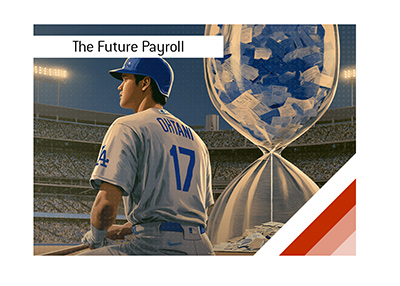
Shohei Ohtani is the best baseball player alive, the reigning back-to-back champion's biggest star, and the holder of a $700 million contract. This season the Los Angeles Dodgers will pay him $2 million in salary. That is not a typo and it is not a dispute. Of his $70 million annual salary, $68 million is deferred every single year, payable from 2034 to 2043 - by which time he will be pushing fifty. He is currently earning less in cash than several members of the bullpen. This is the mechanism at the centre of every complaint about the Dodgers, and it is worth understanding properly, because most of what gets said about it is wrong. The deferrals are legal, the league tried to ban them and the players' union refused, the money is not free because the club must fund it now, and the total on the books has passed a billion dollars owed to nine players with the last cheque due in 2047. This file works through every deferred contract the Dodgers have written - what each player takes home now, what waits for him later, and what the whole arrangement does to a payroll that reads two completely different ways depending on which column you look at.
Sports-King Feature
The Time Machine
Two million dollars now, six hundred and eighty million later. Every deferred contract the Dodgers have written, what it pays today, and the year the bill finally lands.
Los Angeles Dodgers · Earnings Statement · Season 2026EMPLOYEE .......... S. OHTANICONTRACT VALUE .... $700,000,000 OVER TEN YEARS
ANNUAL SALARY ..... $70,000,000
PAID THIS SEASON ..$2,000,000
DEFERRED ..........$68,000,000
PAYABLE ........... JULY 1, 2034 THROUGH 2043COUNTS AGAINST TAX $46,000,000The deferral was the player's own proposal, so the club could keep signing others around him.
Total Deferred, Nine Players$1.06B
Ohtani's Cash This Year$2M
Peak Year, 2038 and 2039$102.3M
Final Cheque Due2047
A deferral is a simple thing dressed up as a scandal. A player agrees to be paid part of his salary years after his contract ends; the club gets to field a better team now; the player gets a longer, larger stream of income and, if he plans it well, a considerably smaller tax bill. Baseball has done this for decades - the most famous example still arrives in a Mets envelope every July. What the Dodgers have done is not new in kind, only in scale, and the scale is genuinely without precedent: $1,064,500,000 owed to nine players in payments running through 2047, on top of everything they are already paying. The reason it works is a single line in the collective bargaining agreement. For luxury tax purposes, deferred money is counted at its present-day value, discounted at the federal mid-term rate. Money promised in 2043 is worth less than money paid in 2026, so the tax charge shrinks even though the promise does not. Eleven contracts below, each with its own stub: what he takes home, what he is owed, and when.
01
Deferral 01 · Signed December 2023 · Ten YearsDEFERRED TOTAL ....$680,000,000PER YEAR .......... $68,000,000 OF $70,000,000
CASH RECEIVED .....$20,000,000 ACROSS TEN YEARS
PAYABLE ........... 2034 TO 2043, EACH JULY 1
INTEREST .......... NONETAX VALUE ......... ~$46,000,000 A YEARPresent-day value of the whole contract: roughly $460 million against a $700 million headline.
The largest deferral in the history of professional sport, and the detail that gets lost is whose idea it was. Ohtani proposed it. He wanted the Dodgers to retain the flexibility to keep building a contender around him, and the structure he suggested - taking $2 million a year and pushing $68 million a decade down the road, with no interest - achieved exactly that. For the club, the arithmetic is transformative: because the collective bargaining agreement discounts deferred money to present value at the federal mid-term rate, which was 4.43 per cent for that offseason, a $70 million salary lands on the tax ledger at about $46 million. Roughly $24 million a year of luxury-tax exposure simply evaporates, and at the penalty rates the Dodgers pay, the saving on the tax bill alone is far larger than that. There is a personal upside too, and it is enormous: California levies the highest state income tax in the country, and if Ohtani is no longer a resident when those cheques arrive from 2034, an estimated $98 million in state tax goes with him.
02
Deferral 02 · Signed July 2020 · Twelve YearsCONTRACT .......... $365,000,000DEFERRED SALARY ...$115,000,000
PAYABLE ........... 2033 TO 2044
SIGNING BONUS TAIL $5,000,000, 2033 TO 2035CONTRACT ENDS ..... 2032, TWELVE YEARS BEFORE PAYMENTThe final instalment arrives twelve years after his contract expires.
Betts is the template. His twelve-year, $365 million extension included $115 million in deferred salary payable from 2033 to 2044, plus the last $5 million of a $65 million signing bonus arriving between 2033 and 2035. The contract itself runs through 2032, which means the Dodgers will still be writing cheques to Mookie Betts twelve years after he stops being contractually obliged to play for them. When this deal was signed it was treated as an eccentricity. It is now the house style, and every deferral the club has written since has followed its logic: pay less now, promise more later, keep the tax number down, and use the difference to sign somebody else.
03
Deferral 03 · Signed November 2024 · Five YearsCONTRACT .......... $182,000,000DEFERRED ..........$66,000,000
INSTALMENTS ....... $5,500,000 A YEAR
PAYABLE ........... EACH JULY 1, 2035 TO 2046ALSO .............. 1% OF SALARY TO CHARITYSnell on the structure: they talked, and found something that worked for both sides.
A third of Snell's contract is deferred - $66 million of $182 million, arriving in identical $5.5 million instalments every July for twelve consecutive years starting in 2035. Until Edwin Diaz signed, that 2046 payment was the last scheduled deferred cheque on the Dodgers' books. What makes Snell's deal instructive is how unremarkable he found it. Asked about the deferrals, he said the arrangement played out the way the people around him were comfortable with, that they talked and found something that worked for both of them. That is the ordinary reality behind an arrangement usually described in conspiratorial terms: agents run the present-value maths, players weigh the tax and security implications, and a number gets agreed. Snell and Tommy Edman each also committed 1 per cent of salary to charity.
04
Deferral 04 · Signed March 2022 · Six YearsCONTRACT .......... $162,000,000DEFERRED ..........$57,000,000
PAYABLE ........... 2028 TO 2040
FIRST INSTALMENT .. $4,000,000 IN 2028STATUS ............ FIRST DEFERRED PAYMENT THE CLUB WILL MAKEEverything in this file is theoretical until this cheque clears.
Freeman's six-year, $162 million contract carries $57 million in deferred money payable from 2028 through 2040, and it holds a distinction none of the others do: his $4 million instalment in 2028 is the first deferred payment the Dodgers will actually make. Every argument about this strategy - that it is a loophole, that it mortgages the future, that it will one day come due - remains an argument until that cheque is written. It is also a useful reminder of the timescale involved. The Freeman contract expires after the 2027 season. The payments then run for another thirteen years, which is longer than most players' entire careers, to a man who by then will have been retired for over a decade.
05
Deferral 05 · Signed March 2024 · Ten YearsCONTRACT .......... $240,000,000DEFERRED ..........$50,000,000
PAYABLE ........... 2034 TO 2043NOTE .............. THE SAME WINDOW AS OHTANITwo of the largest obligations land in identical years, which is how 2034 gets expensive.
The catcher's ten-year, $240 million extension defers $50 million into exactly the same window as Ohtani's: 2034 through 2043. That overlap is not an accident of scheduling so much as a consequence of both deals being ten-year commitments signed within months of each other, but it matters to the shape of the obligation. When people ask what the Dodgers will owe in the mid-2030s, the answer is not one enormous contract, it is several stacked on top of each other. Smith is the quiet example of how far the practice extends beyond the marquee names - a very good player on a very large contract, structured the same way, generating the same tax relief.
06
Deferral 06 · Two Contracts · 2024 and 2025ONE-YEAR DEAL 2024 $23,500,000DEFERRED FROM IT ..$8,500,000
THREE-YEAR DEAL ... $66,000,000
DEFERRED FROM IT ..$23,500,000
COMBINED ..........$32,000,000 TO 2039THIS SEASON ....... $4,000,000 CASH, ~$19,960,000 TO TAXThe clearest proof it is a system, not a superstar exception.
If you want the single entry that shows this is institutional rather than opportunistic, it is this one. Hernandez signed a one-year deal for 2024 - a single season, a rental, the sort of contract nobody bothers to structure cleverly - and $8.5 million of it was deferred, payable in $850,000 instalments every July from 2030 to 2039. He then re-signed for three years and $66 million with a further $23.5 million deferred. Combined, the Dodgers owe him $32 million long after he has gone. This season he is deferring $8 million of a $12 million salary, so his actual cash is $4 million while his tax charge is close to $20 million. The Dodgers do not do this only for players like Ohtani. They do it for everybody who will agree to it.
07
Deferral 07 · Signed January 2026 · Four YearsCONTRACT .......... $240,000,000SIGNING BONUS ..... $64,000,000
SALARY 2026 .......$1,000,000
DEFERRED ..........$30,000,000, 2027 TO 2029
PAYABLE ........... $1,000,000 A YEAR, 2036 TO 2045TAX VALUE ......... ~$57,100,000 A YEARThe Mets reportedly offered $220 million with no deferrals. He took the deferred deal.
Tucker's contract is the clearest demonstration of why players accept these terms, because it contains a bidding war with a visible loser. The Mets reportedly offered $220 million across four years with no deferrals. The Dodgers offered $240 million with $30 million deferred - $10 million from each of the final three seasons, paid back at $1 million a year from 2036 to 2045. Tucker took the bigger headline number. Deferrals let a club post a larger figure than a rival can match while paying less in present-value terms, and they let a player claim a bigger contract. There is a tax wrinkle too: Tucker is a Florida resident, and taking $64 million of the deal as a signing bonus rather than salary is estimated to have saved him around $9.2 million against California rates. Everybody in this transaction was optimising something.
08
Deferral 08 · Signed November 2024 · Five YearsCONTRACT .......... $74,000,000DEFERRED ..........$25,000,000
PAYABLE ........... INTO THE 2040sALSO .............. 1% OF SALARY TO CHARITYReported payment windows differ slightly between sources - see the fine print.
Edman's five-year, $74 million extension defers $25 million, roughly a third of the deal, into the 2040s. He is a valuable utility player rather than a superstar, and that is precisely the point of including him. The Dodgers are not merely structuring one or two enormous contracts creatively; they are running the same play across the roster, at every salary level, which is how the aggregate reached a billion dollars in the space of a few winters. A note on precision: reported payment windows for this contract differ slightly between outlets - some place it 2035 to 2044, others 2037 to 2044 - which is a good illustration of how much of this information reaches the public second-hand rather than from filed documents.
09
Deferral 09 · Signed January 2025 · Four YearsCONTRACT .......... $72,000,000DEFERRED ..........$21,000,000
PAYABLE ........... 2035 TO 2046SHARE DEFERRED .... NEARLY THIRTY PER CENTA four-year contract generating obligations across twelve.
A four-year, $72 million contract for a relief pitcher, with $21 million of it deferred across 2035 to 2046. Consider the mismatch: the playing commitment lasts four seasons, the payment obligation runs twelve years beyond it. Scott's deal, alongside Hernandez's, was the pair that pushed the Dodgers past $1.05 billion in deferred obligations and prompted the commissioner to acknowledge publicly that fans in other markets were concerned about their clubs' ability to compete. Note also what the deferral does not do: it does not reduce what the club ultimately pays. Scott gets every dollar. It changes when, and therefore what the number looks like on this year's tax ledger.
10
Deferral 10 · Signed December 2025 · CloserCONTRACT .......... $69,000,000SIGNING BONUS ..... $9,000,000
DEFERRED ..........$4,500,000 A YEAR
TOTAL DEFERRED ....$13,500,000
FINAL PAYMENT ..... 2047MILESTONE ......... PUSHED THE TOTAL PAST $1.064 BILLIONTwenty-one years from now, the Dodgers will still be paying for the 2026 bullpen.
Diaz's signing did two things. It fixed the back of the bullpen, and it extended the Dodgers' obligation calendar by a further year - his 2028 deferrals are payable from 2038 through 2047, making that the final scheduled cheque on the books. The structure is now familiar: $4.5 million deferred annually, each tranche repaid in ten equal instalments a decade later. It also took the club past $1,064,500,000 in total deferred obligations owed to nine players. The Dodgers will be paying for a reliever they signed in 2025 until a season that has not been scheduled, in a stadium that may not exist, under a collective bargaining agreement that has not been written.
11
Deferral 11 · Article XVI · The Part Nobody MentionsLIMIT ON DEFERRALS NONEMUST BE FUNDED BY THE SECOND JULY 1 AFTER
THE SEASON IT IS EARNED
FUNDING DISCOUNT . 5% ANNUALLY
TAX DISCOUNT ..... 4.43% FEDERAL MID-TERM
SO CLUB FUNDS .... ABOUT 95% OF THE OBLIGATIONPEAK OBLIGATION .. $102,300,000 IN 2038 AND 2039Two different discount rates govern the same dollar. That gap is the entire edge.
Here is the correction to the standard complaint, and it is more precise than most coverage manages. Article XVI of the collective bargaining agreement places no limit whatsoever on how much of a contract may be deferred - none - but it does require clubs to fully fund the present value of the obligation on or before the second July 1 following the season in which the money is earned. The Dodgers cannot simply promise 2043 dollars and forget about them; the cash goes into an account earmarked for that player, held in liquid form, with the union entitled to monitor compliance. The club's president of baseball operations has been blunt: it is just how you account for it, and you have to fund a lot of it right now. But notice the detail almost nobody reports. Funding is calculated with the outstanding payments discounted at 5 per cent a year, while the luxury tax is calculated by discounting at the federal mid-term rate - 4.43 per cent for Ohtani's signing. Two different rates govern the same dollar, and the club need only put up roughly 95 per cent of the deferred amount because the remaining 5 per cent is assumed to be earned by investing it. What a deferral genuinely buys is that spread, plus a two-year grace period before funding begins. It is an edge, it is legal, and it is available almost exclusively to owners with enormous capital already behind them - which is precisely why it solves nothing for the clubs complaining about it.
The Full Ledger
Every deferred obligation on the Dodgers' books, largest to smallest, with the years each is payable.
| Player | Contract | Deferred | Payable | Share Deferred |
|---|---|---|---|---|
| Shohei Ohtani | $700M / 10 yrs | $680.0M | 2034-43 | 97% |
| Mookie Betts | $365M / 12 yrs | $115.0M + $5M bonus | 2033-44 | 33% |
| Blake Snell | $182M / 5 yrs | $66.0M | 2035-46 | 36% |
| Freddie Freeman | $162M / 6 yrs | $57.0M | 2028-40 | 35% |
| Will Smith | $240M / 10 yrs | $50.0M | 2034-43 | 21% |
| Teoscar Hernandez | Two deals | $32.0M | 2030-39 | Varies |
| Kyle Tucker | $240M / 4 yrs | $30.0M | 2036-45 | 13% |
| Tommy Edman | $74M / 5 yrs | $25.0M | 2030s-2044 | 34% |
| Tanner Scott | $72M / 4 yrs | $21.0M | 2035-46 | 29% |
| Edwin Diaz | $69M | $13.5M | 2036-47 | 20% |
| Total, nine players before Tucker | - | $1,064.5M | Through 2047 | - |
The Arithmetic
One roster, two payrolls
Trackers differ on the exact tax figure because each estimates benefits and minor-league salaries differently, so this file shows the range rather than pretending to a single number. The point survives either way.
The obligation calendar - 2028 to 2047
The Ohtani window opens in 2034 and the obligations stack immediately, because Will Smith's deferrals run on the same schedule. The two heaviest years are 2038 and 2039, at $102.3 million each.
The Record Book
The League Tried to Ban ItThe most inconvenient fact for anyone calling deferrals a loophole: Major League Baseball formally proposed ending the practice during collective bargaining on June 21, 2021, and the players' association rejected the change. The union protects deferrals because they are a tool players use - for tax planning, for income security stretching decades past retirement, and for extracting larger headline totals from clubs. The commissioner's own position is careful: the Dodgers have done everything possible within the rules, and that competitive spirit is good for the game, while fans in some markets are understandably worried about whether their team can compete. Both halves of that are true.
The Bonilla PrecedentNone of this is new. The most famous deferred contract in sport belongs to Bobby Bonilla, who agreed in 2000 to be bought out of the remainder of his Mets deal in exchange for annual payments beginning in 2011 and running to 2035 - producing an internet holiday every July 1 when the cheque arrives. The Mets made that arrangement because they expected to invest the money at a better rate than the deferral cost them. That is precisely the Dodgers' logic, at roughly two hundred times the scale, and it is why the club's baseball operations chief has called the outrage a lazy narrative that unfairly lumps ordinary deferrals in with the Ohtani deal.
The Arizona WarningThere is a precedent for deferrals going wrong, and the commissioner brings it up himself. Arizona, he has said, once got into genuine financial difficulty as a result of excessive deferrals - which is why the league strengthened its funding rules, so that the money is guaranteed to be there when the player is finally owed it. His remaining concern is not the player's security but the owner's: escrow assures the money exists, he notes, but it does not solve the problem that you are selling a club with a large mortgage on its future. That is the genuine long-term question hanging over this strategy. Not whether the Dodgers can pay, but what the franchise looks like to a buyer in 2035 with a hundred million dollars a year still going out to men who stopped playing a decade earlier.
Where the Tax Money GoesThe luxury tax is not a fine that vanishes into a league office. Under Article XXIII of the collective bargaining agreement, the first $3.5 million of the total collected goes toward player benefits, and half of what remains funds player retirement accounts, with the balance distributed to clubs that stayed under the threshold and meet revenue criteria. So the Dodgers' record $169.4 million is not a penalty in any ordinary sense - a large share of it is redistributed to the players and the very teams complaining about them. One curiosity from the same filing: the Dodgers' 2025 tax calculation included $949,244 in non-cash compensation for Ohtani, covering a suite at Dodger Stadium for his games and the cost of his interpreter. Even the perks are taxed.
The Contract With No DeferralsThe tidiest corrective to the whole argument sits on the Dodgers' own roster. When Yoshinobu Yamamoto arrived from Japan on a twelve-year, $325 million contract, not a single dollar of it was deferred - and the club paid a $50.6 million posting fee to his former team on top of the contract itself. Roki Sasaki arrived through the same system. Deferrals explain how the Dodgers keep the tax number down. They do not explain a decade of international scouting, or a player-development operation that has been converting other clubs' castoffs into contributors for years. The money is the loudest part of the answer. It is not the whole answer.
What the Bill Looks Like NowDeferrals reduce the tax charge; they do not eliminate it. For the 2025 season the Dodgers posted a luxury-tax payroll of $417,341,608 and a tax bill of $169,375,768 - both records, taking the total cost of that roster to roughly $587 million in the league's accounting, and exceeding the entire tax payroll of twelve clubs. Their bill alone was larger than the combined total of every team except the Mets. It also pushed them past the Yankees for the most luxury tax paid by any franchise since the penalty began in 2003, $519.4 million to $514.2 million. A record-tying nine clubs paid, and the combined $402.6 million shattered the previous high of $311.3 million set the year before. Whatever else deferrals do, they have not made the Dodgers cheap.
Sports-King's Note
Now for the fine printSources and their limits. Contract terms come from Associated Press reporting of documents obtained at signing, ESPN's running tally of the Dodgers' deferred obligations, and club-focused outlets that track payroll contract by contract; none of these are filed public documents, so details occasionally differ between them. The headline total of $1,064,500,000 owed to nine players through 2047 is ESPN's figure following the Edwin Diaz signing in December 2025 - it does not include Kyle Tucker's $30 million, agreed the following month, which would take the total to roughly $1.09 billion; this file uses the nine-player figure where it cites the total and states Tucker separately, because that is how the number was reported. Payment windows are as reported: Ohtani $680 million 2034-43, Betts $115 million in salaries 2033-44 plus $5 million of signing bonus 2033-35, Snell $66 million in $5.5 million instalments each July 1 from 2035-46, Freeman $57 million 2028-40 beginning with $4 million, Smith $50 million 2034-43, Hernandez $32 million across two contracts payable 2030-39, Tucker $30 million deferred from his 2027-29 salaries and repaid $1 million annually each December 1 from 2036-45, Scott $21 million 2035-46, and Diaz $13.5 million with tranches running as late as 2047. Edman's $25 million is reported with differing windows - some sources say 2035-44, others 2037-44 - and the ledger reflects that uncertainty rather than choosing arbitrarily. Luxury-tax payroll figures differ by tracker: Spotrac put the 2026 competitive balance tax payroll at $413.6 million, a club-focused analysis calculated $410.8 million on opening day, and FanGraphs had $398.6 million in January, because each makes different assumptions about player benefits, minor-league salaries on the 40-man roster and each club's share of the pre-arbitration bonus pool - so this file quotes a range. Cash payroll of roughly $262 million for 2026 and last season's $417.3 million tax payroll and $169.4 million tax bill are as reported. Ohtani's tax valuation of about $46 million follows from the collective bargaining agreement's discounting of deferred money at the federal mid-term rate, 4.43 per cent for the offseason in which he signed. Estimates are labelled as such throughout: the roughly $98 million in California state tax Ohtani could avoid depends entirely on his residency when payments arrive and on tax law two decades from now, and the $9.2 million attributed to Tucker's signing-bonus structure is likewise an estimate. Funding requirements come from Article XVI of the collective bargaining agreement, which places no limit on deferred compensation but requires clubs to fully fund the present value of the obligation on or before the second July 1 following the championship season in which it is earned, with fully funded defined as the present value of outstanding payments discounted at 5 per cent annually, held in liquid earmarked assets that remain subject to the claims of the club's general creditors, and with union compliance monitoring - as summarised in legal analyses of the agreement. The distinction between that 5 per cent funding discount and the federal mid-term rate used for the tax calculation is drawn from the same sources. Luxury tax figures are the final calculations finalised by MLB and the players' association and obtained by the Associated Press for the 2025 season: a Dodgers tax payroll of $417,341,608 and a bill of $169,375,768, a two-year Dodgers total of $272.4 million, a record-tying nine clubs paying, and a combined $402.6 million against the previous high of $311.3 million set in 2024 - note that some outlets reported the 2025 combined total as $401.3 million, and this file uses the Associated Press figure. Tax proceeds are distributed per Article XXIII of the agreement. The Arizona deferral difficulties and the observation about selling a club with a mortgage on its future are the commissioner's own remarks in a recorded interview. Nothing here alleges any rule has been broken, because none has.
One Last Word
The most remarkable thing in this file is not the billion dollars. It is that the best player in the world looked at his own contract and volunteered to be paid last, so that his employer could go and sign somebody else. Every argument about competitive balance runs through that decision, and no rule change addresses it, because there is no rule against a player wanting to win badly enough to wait twenty years for his money. The Dodgers did not find a loophole. They found a superstar who cared more about the roster than the cash flow, and then they built a system around him.
The hard numbers, for the road: the Dodgers owe $1,064,500,000 in deferred salary to nine players in payments running through 2047, with Kyle Tucker's $30 million taking it to roughly $1.09 billion. Shohei Ohtani takes $2 million in cash this season while $68 million a year waits for him from 2034 to 2043, and because the collective bargaining agreement discounts deferred money at the federal mid-term rate, his $70 million salary counts about $46 million against the tax. The result is a cash payroll near $262 million against a luxury-tax payroll reported between $411 million and $414 million, on a $244 million threshold. Last season's bill was $169,375,768 on a $417.3 million tax payroll, both records, and it moved them past the Yankees for the most luxury tax paid by any club since 2003. The first deferred cheque lands in 2028, with Freddie Freeman receiving $4 million; the heaviest years are 2038 and 2039 at $102.3 million each; the last payment is due in 2047. Major League Baseball proposed banning deferrals in 2021 and the players' union said no. And not one dollar of Yoshinobu Yamamoto's $325 million contract was deferred.