
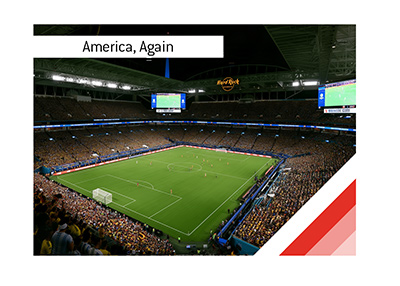
 South America's biggest international football tournament is returning to the United States.
Again.
CONMEBOL and CONCACAF have confirmed that the 2028 Copa America will take place in the US, with all ten South American nations joined by six teams from North and Central America and the Caribbean.
It will be the third time in five editions that the tournament has been held in the United States, following 2016 and 2024.
For a competition that dates back to 1916, that is quite a change.
And when you look at what else has been happening in international football, it becomes difficult not to notice a pattern.
America's Growing Collection of Football Tournaments
In 2024, the United States hosted the Copa America.
In 2025, it hosted FIFA's expanded 32-team Club World Cup.
In 2026, it co-hosted the FIFA World Cup with Canada and Mexico, staging 78 of the tournament's 104 matches.
Now the Copa America is returning in 2028, the same year Los Angeles hosts the Summer Olympics.
In fact, the Copa America final is scheduled for July 9, just one day before the Olympic men's football tournament begins.
3 of 5Copa America editions held in the US, 2016-2028
78/1042026 World Cup matches played in the United States
1 dayFrom the 2028 Copa final to the start of Olympic men's football
The US Hosting Calendar
Selected major tournaments, 2024-2028
2024Copa AmericaSouth America's championship in the US
2025Club World CupExpanded 32-team tournament
2026FIFA World CupCo-hosted with Canada and Mexico
2028Copa America + OlympicsUS tournament; Los Angeles Summer Games
That is an extraordinary concentration of major sporting events in one country.
The United States is not hosting everything, of course. The 2030 World Cup will be played primarily in Spain, Portugal and Morocco, while Saudi Arabia has secured the 2034 tournament.
But why are so many of football's major competitions suddenly finding their way to America?
Follow the MoneyThe financial explanation is fairly straightforward.
CONMEBOL reported approximately $319 million in revenue from national-team competitions in 2024, a year dominated by the Copa America held in the United States.
For comparison, the 2019 Copa America in Brazil generated approximately $118 million.
The Revenue Contrast
Reported CONMEBOL figures | USD millions
2019 Copa America
Brazil$118M
2024 national-team competitions
Including US Copa America$319M
Not like-for-like: 2019 is the Copa America tournament figure; 2024 includes all CONMEBOL national-team competitions, not only Copa America. The difference cannot be attributed entirely to the host country.
The figures are not perfectly comparable, but they help explain the appeal of the American market.
The United States has enormous stadiums, lucrative broadcasting agreements, major corporate sponsors and millions of football supporters from South American backgrounds.
For CONMEBOL, the opportunity to generate additional revenue is difficult to ignore.
But should money be the deciding factor in where a continental championship takes place?
What about supporters in Argentina, Brazil, Uruguay, Colombia and the other South American countries?
How many can realistically afford to travel to the United States to watch their national teams compete?
And is the tournament necessarily better because it generates more revenue?
The 2024 Copa America final in Miami was delayed by nearly 90 minutes after serious problems with crowd control and stadium access.
The American market offers considerable advantages, but hosting the tournament there does not automatically guarantee a better experience for supporters.
America's Influence Over FIFAThere is also a political and historical dimension worth considering.
In 2015, American authorities launched a major corruption investigation into FIFA and international football officials.
The investigation exposed allegations of widespread bribery and corruption involving television rights, sponsorships and other commercial arrangements.
It helped bring an end to the Sepp Blatter era.
Gianni Infantino eventually took over as FIFA president in 2016, elected by FIFA's member associations.
There is no evidence that the United States installed Infantino as president, but American financial interests have become increasingly prominent in the discussions surrounding FIFA's future.
Consider what happened earlier this year.
Infantino backed a proposal to establish FIFA Forward Enterprise, a commercial operation that would have allowed private investors to acquire a stake in FIFA's commercial rights.
The proposed venture carried an initial valuation of approximately $20 billion, with American investment firm Thrive Capital involved as the lead investor.
Documents subsequently revealed that the arrangement could have transferred FIFA's commercial rights to the new enterprise for as long as 96 years.
FIFA Forward Enterprise
Proposed in 2026 · Abandoned
$20BInitial valuation of the proposed commercial venture
96 yearsMaximum proposed commercial rights term
These were proposed terms, not an agreement that took effect.
Think about that.
Commercial rights to international football competitions potentially committed for almost a century.
The proposal was eventually abandoned following opposition from UEFA and others. FIFA also denied that Infantino would have personally benefited from the arrangement.
The deal never happened.
But the fact that such an arrangement was seriously considered raises important questions about the direction in which international football is heading.
Who Is Football Really Being Organized For?It would be wrong to suggest that the United States is somehow forcing other countries to surrender their football tournaments.
CONMEBOL agreed to bring the Copa America back. FIFA selected the United States for its expanded Club World Cup. These decisions were made by football's governing organizations.
And the financial benefits can be substantial.
More revenue can mean greater investment in football development, national associations and clubs throughout the world.
There are legitimate reasons to pursue that money.
But where does it end?
If the Copa America generates more revenue in the United States than in South America, should it simply keep returning to America?
Could the same eventually happen with other continental competitions?
And how much influence should commercial partners and private investors have over decisions that were traditionally made for sporting reasons?
The United States has become one of the world's most attractive markets for international football.
That much is clear.
What is less clear is whether the governing bodies are adequately considering the interests of the supporters and countries whose competitions they are moving.
The 2028 Copa America may prove to be another financial success.
But South American football supporters have every reason to ask why their own continental championship keeps being played somewhere else.