From Braddock to Buster Douglas to Andy Ruiz: The Longshots Who Beat the Price
Published on September 25th, 2026Written By: Dave Manuel
Everyone has a list of the biggest upsets in boxing history. Most of them are built on reputation and memory. I wanted to build one on the only number that was on the board before the opening bell: the betting price. Here are twelve famous shocks, ranked by how much chance the market actually gave the underdog - and a few of the legendary numbers turn out to be a little different from the way they're usually told.
How to read the meter. A betting price is a probability in disguise. A 20-1 underdog is being given one chance in 21, or 4.8 percent. A -4200 favorite is being given 97.7 percent, which leaves 2.3 percent for the other man. These are raw figures, straight from the price, and they include the bookmaker's margin, so the underdog's true market chance was a touch lower still. It is the same arithmetic we run on every board in our odds methodology.
Old boxing lines are messy. They changed from book to book and from open to close, and sometimes only one side of the price survives in the record. Where that happens, the entry below shows the range and says which number the meter uses. Where a book only printed the favorite, the meter shows the most chance that price could have left the underdog.
The Ledger, Longest Shot First
Buster Douglas over Mike Tyson
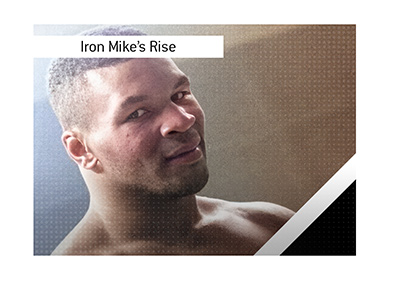
This is the bottom of the meter, and it may stay there forever. Tyson had knocked out almost everyone in front of him, the fight was widely treated as a tune-up before a showdown with Evander Holyfield, and most Las Vegas books did not bother to post a moneyline at all. They offered props on which round Tyson would end it instead.
Douglas got up from an eighth-round knockdown and stopped Tyson in the tenth. Tyson's corner was so unprepared for a real fight that it had no ice bag or endswell for his closing eye, and worked on it with a latex glove filled with water. The Mirage wrote one Tyson ticket for $168,000 to win $4,000. Nobody came back to collect it.
The most famous number in boxing betting is attached to the wrong fighter. 42-1 was Tyson's price, -4200, at the Mirage. The Mirage opened Douglas at 27-1, and the bookmaker who ran that counter has said the biggest Douglas ticket he wrote was $1,000 at 37-1. So nobody collected 42-1 on Buster Douglas. The real number is still the biggest upset in the history of the sport. It just is not the one on the documentary poster.
Andy Ruiz Jr. over Anthony Joshua
Ruiz got the fight on roughly a month's notice after Jarrell Miller failed drug tests, and the market treated him like what he looked like on paper: a late replacement for a champion making his American debut. One book reported 92 percent of tickets and 96 percent of the money on Joshua. A Nevada bettor put $100,000 on him to win $5,000.
Joshua dropped Ruiz in the third and then got knocked down four times himself before the stoppage in the seventh. Ruiz became the first heavyweight champion of Mexican heritage. Joshua won the rematch six months later in Saudi Arabia, but the first fight is the one on this list, and it is the closest anyone has come to Tokyo.
Hasim Rahman over Lennox Lewis
Lewis arrived late to altitude, fought at five in the morning local time so HBO could show it on a Saturday night in America, and had spent part of his camp around the filming of Ocean's Eleven while talks for a Tyson fight went on in the background. He was ahead on all three cards after four rounds.
Then one right hand in the fifth ended it. Larry Merchant said on the broadcast that Lewis had drowned in Ocean's Eleven. Lewis knocked Rahman out in the rematch that November and took his belts back, which is the usual postscript for this kind of night.
Corrie Sanders over Wladimir Klitschko
Sanders was a 37-year-old southpaw who had boxed only twice in three years, and this was supposed to be the first fight of a new HBO deal for Klitschko. The market gave him about one chance in twenty.
He needed less than two rounds. Sanders put Klitschko down four times in two rounds with fast, heavy left hands, and anyone who had taken the long price with a UK bookmaker had a very good night. Klitschko went on to one of the longest title reigns in heavyweight history, which is exactly why this loss still looks so strange on his record.
Frankie Randall over Julio Cesar Chavez
Chavez came in with 89 wins, one draw and no losses, one of the great unbeaten runs in the history of the sport. Randall was a solid professional, and the market saw nothing more than that.
Randall became the first man to put Chavez on the canvas, and he won a split decision. Chavez was also docked points for low blows, which mattered on the cards. Randall is the only fighter outside the heavyweights in the top half of this list, and his win is a useful reminder that a long price is not only a heavyweight thing. It is just rarer when one punch cannot settle it.
Evander Holyfield over Mike Tyson
This is the clearest example of the number the legend remembers not being the number most people bet. The 25-1 was real, but it was the opener. By fight time Tyson had settled around 1/10, which still gave Holyfield less than a one-in-ten chance, and some in the media openly feared for Holyfield's health.
Holyfield did not run. He stood in the center of the ring, took Tyson's best, gave it back harder, and the referee stopped it in the eleventh. The rematch the next summer is remembered for other reasons.
James J. Braddock over Max Baer
The Cinderella Man. Braddock had lost so often in the late 1920s and early 1930s that he gave up the ring, worked on the docks and went on relief to feed his family through the Depression. When he got a title shot, Baer treated it as an easy payday.
Braddock boxed carefully for fifteen rounds and took a clear decision. His 10-1 stood for decades as the benchmark for a heavyweight title longshot, which is why Douglas at 37-1 was so far off the charts in 1990 that almost no book would print it.
Leon Spinks over Muhammad Ali
Spinks was an Olympic gold medalist in only his eighth professional fight. Ali was fading, but he was still Ali, and the market could not see a novice taking the heavyweight championship from him.
Spinks won the last three rounds on all three judges' cards and took a split decision. It made him the only man ever to take the title from Ali in the ring, since Ali's other defeats came in non-title fights or with Ali as the challenger. Ali won the rematch seven months later.
Srisaket Sor Rungvisai over Roman Gonzalez
Gonzalez was the pound-for-pound king, unbeaten in 46 fights and a four-division champion. Sor Rungvisai put him down in the first round and fought him to a standstill for twelve, while also losing a point for head butts.
The majority decision went to the Thai, and plenty of ringside observers thought Gonzalez deserved it. That debate does not change the ticket. Sor Rungvisai removed any doubt six months later by knocking Gonzalez out in four.
Cassius Clay over Sonny Liston
Liston was the most feared heavyweight of his time, and Clay was a loud young Olympic champion most writers expected to get hurt. The price reflected that.
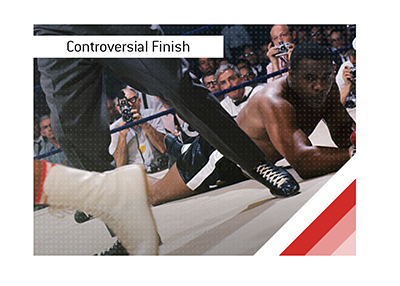
Clay was too fast, and Liston did not come out for the seventh round. The fighter who would soon become Muhammad Ali appears twice on this list: once here as the longshot, and once as the fallen favorite against Spinks.
Vernon Forrest over Shane Mosley
By the market's numbers this was the mildest upset on the list, but it rattled the pound-for-pound rankings. Mosley was considered one of the best fighters in the world.
Forrest used his height and reach, dropped Mosley twice in the second round and won a clear unanimous decision. It is a good example of why a -400 favorite is not a sure thing: the market was saying Forrest would win this fight roughly one time in five or six.
George Foreman over Michael Moorer
Here is the upset the price did not see as an upset at all. Foreman was 45, and critics called the fight a joke, but his name and his punch kept the line short.
He was losing on the cards until one right hand in the tenth made him the oldest heavyweight champion in history. It is on this list as a warning in the other direction: some of the most famous shocks were not long prices, and the meter is the honest way to tell the difference.
What the Meter Teaches
The heavyweights own the far end of the meter. Nine of the twelve shocks here were heavyweight fights, including six of the seven longest prices. One punch can erase twelve rounds of evidence, and the big men carry that punch.
Most of the biggest shocks were knockouts. Seven of these twelve ended inside the distance. Of the five that went to the cards - Braddock, Spinks, Randall, Sor Rungvisai and Forrest - only Randall sits in the top half of the meter. That is a historical pattern, not a law, but it is worth remembering whenever an underdog price and a method-of-victory market sit side by side.
The favorite was often already looking at the next fight. Tyson was a step away from Holyfield. Lewis was talking Tyson and spending time on a film set. Joshua was making his American debut against a late replacement. Klitschko was starting a new television deal. None of that is proof of anything on its own, but the pattern is hard to ignore.
The public piles on the favorite. The $168,000 Tyson ticket, the $100,000 Joshua bet and the 96 percent of money on Joshua at one book all tell the same story. Laying a huge price means risking a lot to win a little, and on these nights the little never came.
The famous number is usually the opener, or one book's number. Holyfield's 25-1 was an opening line. Douglas's 42-1 was Tyson's price. Ruiz's price depended on where you bet. If a number sounds too clean for a messy market, it usually is.
One Last Word
Every one of these nights started the same way, with a price that said the favorite should win and a crowd that believed it. The price was usually right about the probability. It just could not promise which way the one night would fall. That is the whole lesson of boxing betting in a sentence: a 2.3 percent chance is small, but it is not zero, and Buster Douglas only needed it once.
About these numbers: historical boxing lines come from contemporary reports and from the bookmakers who set them, and they were rarely uniform. Where sources disagree we show the range. Implied probabilities are calculated directly from the quoted prices and include the bookmaker's margin. The meter ranks the fights by the price that best reflects fight time where it is known; opening prices are noted separately.
This article is a history of prices, not a betting tip. Betting is for adults 18 and over, or 21 and over where local law requires it. Please gamble responsibly.