
The French Motorcycle Grand Prix combines one of MotoGP's largest crowds with a circuit that puts braking, acceleration and judgement under close examination. Held at Le Mans, it is a major event in its own right as well as an important stop in the world championship.
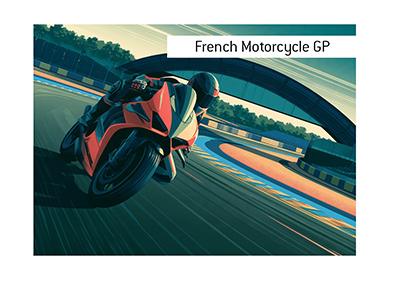 The race uses the permanent Bugatti Circuit within the Le Mans complex. It is separate from the Formula 1 French Grand Prix and from the 24 Hours of Le Mans car race, which uses the longer Circuit de la Sarthe.
For motorcycle racing fans, the attraction is the combination of a demanding track, passionate home support and a recent history of unpredictable results.
The 2027 French Motorcycle Grand Prix
The 2027 race weekend takes place from May 14 to 16. The MotoGP Sprint is scheduled for Saturday, May 15, followed by the Grand Prix on Sunday, May 16.
Le Mans is the seventh round of the published 2027 calendar, immediately after the Spanish Grand Prix at Jerez. That sequence gives teams little time between the two events, making information gathered during practice particularly valuable.
The new season brings 850cc engines, a switch to Pirelli tyres and a ban on ride-height and holeshot devices. Those changes make the latest performance data more useful than assuming a manufacturer will retain its previous advantage at Le Mans.
Moto2 and Moto3 also form part of the weekend, with their own races and championship battles. Results in those categories should be distinguished from the premier-class MotoGP event.
History of the Race at Le Mans
The Bugatti Circuit was built in 1965, and Le Mans first hosted a motorcycle world championship Grand Prix in 1969. Giacomo Agostini won the 500cc race that year on an MV Agusta.
The French round has used different venues during its history, but Le Mans has been its regular home since 2000. In 2023, the circuit hosted the championship's 1,000th Grand Prix meeting, giving that year's event a significance beyond the individual race results.
The modern crowd is a major part of its identity. The Automobile Club de l'Ouest reported a weekend attendance of 311,638 for the 2026 event. That is a cumulative weekend figure, rather than the number of people present for Sunday's race alone.
French riders add to the atmosphere. Johann Zarco's 2025 victory gave the home crowd a premier-class winner at the French Grand Prix for the first time since 1954, ending a wait of more than seven decades.
The Bugatti Circuit
The track measures 4.185 km and contains nine right-hand corners and five left-hand corners. Its longest straight is 674 metres, but much of the competitive work takes place in the braking zones and on corner exits.
Le Mans repeatedly asks riders to slow the motorcycle, change direction and accelerate while controlling rear-wheel traction. A fast approach is only useful if the rider can complete the corner cleanly and get back on the throttle without losing ground.
That creates a balance between attacking and preserving the tyres. A rider who repeatedly brakes too late may gain a position temporarily but compromise the exit. Someone following closely can exploit that loss of acceleration at the next opportunity.
Track conditions also deserve attention. A dry practice session does not settle the order for a wet race, and changing conditions can make tyre selection more important than a small advantage in qualifying pace.
The 2025 race showed how strongly that factor can influence the result. Zarco's decision to use wet tyres helped him win by almost 20 seconds over Marc Marquez.
Race Weekend Format
The 2027 format gives the Sprint and Grand Prix separate starting grids. Sprint qualifying takes place on Friday, while Grand Prix qualifying is held on Saturday. The Sprint follows on Saturday afternoon, with the main race on Sunday.
The shorter Sprint awards 12 points to its winner, compared with 25 for winning the Grand Prix. A rider who wins both can therefore collect 37 championship points.
For anyone assessing the weekend, the distinction matters. A strong Sprint can demonstrate immediate pace, but the longer race asks more of tyre management and consistency. The two grids can also leave the same rider facing different overtaking demands.
Recent French MotoGP Winners
These are the winners of the Sunday premier-class Grand Prix, rather than the Sprint.
2026: Jorge Martin - Aprilia
2025: Johann Zarco - Honda
2024: Jorge Martin - Ducati
Martin's two victories came on different manufacturers' motorcycles. His 2024 success followed a close contest with Marc Marquez and Francesco Bagnaia, while his 2026 win required a late recovery through the leading group.
Zarco's victory between those two results is another reason to look beyond a simple manufacturer trend. Conditions, rider confidence and the decisions made during a race weekend can change the competitive order.
What Happened at Le Mans in 2026?
Jorge Martin won the Grand Prix ahead of Aprilia teammate Marco Bezzecchi, with Trackhouse rider Ai Ogura taking third. All three podium places therefore went to riders using Aprilia machinery.
Bezzecchi led much of the race, but Martin closed the gap in the latter stages and passed him with three laps remaining. Ogura also made progress late in the contest, securing his first MotoGP podium.
The result completed a double for Martin after his Sprint victory on Saturday. It was his first Sunday Grand Prix win since the 2024 Indonesian round.
Francesco Bagnaia had been involved near the front before crashing at Turn 3. Fabio Quartararo finished sixth at his home event, while defending race winner Zarco took eleventh.
The contrast between early positions and the final podium makes this a useful race to revisit when assessing sustained pace. The leading rider halfway through was not the eventual winner.
French Motorcycle Grand Prix Betting Markets
Grand Prix winner: This market concerns Sunday's main race. Compare qualifying position with longer practice runs, recent race performance and the expected conditions.
Sprint winner: The Saturday race has its own winner market. Its shorter distance and separate grid mean it should be assessed on its own terms.
Podium finish: Where offered, this selection requires the rider to finish in the top three. A rider can offer a credible podium challenge without being the strongest candidate for victory.
Head-to-head: These markets compare the finishing positions of two riders. They can focus attention on a particular matchup, including differences in braking confidence, tyre use and starting position.
Qualifying markets: Check whether the selection applies to Sprint qualifying or Grand Prix qualifying. From 2027, those sessions decide different grids.
Bookmakers may also offer finishing-position or fastest-lap markets. Availability varies, and settlement rules should be checked for retirements, penalties, shortened races and non-starters.
What to Watch Before the Race
Start by separating single-lap speed from race pace. A fast qualifying lap may involve a fresh tyre and a clear track, while a race run reveals more about consistency as grip changes.
At Le Mans, braking confidence and traction deserve particular attention. Watch whether a rider can repeat the same corner entry without running wide or losing acceleration on the exit.
The weather forecast should then be compared with the conditions in which the useful practice data was recorded. If Sunday's surface is different, the apparent order from Friday may need to be reassessed.
Finally, use the confirmed grid and current price together. Past success at Le Mans is relevant, but the 2027 motorcycles and tyres make recent evidence essential.