
 The most recent winner was Nibret Melak, who ran 2:04:00 in 2026. Anchinalu Dessie took the women's title after a late change of leader, completing another Ethiopian double.
The 26th Dubai Marathon takes place on Sunday, January 17, 2027.
The 2027 Dubai Marathon
The event returns to January after its February 1 date in 2026. The programme includes the full marathon, a 10km Road Race and a 4km Fun Run, all held on the same day.
The published schedule gives the elite marathon runners a 5:45 am start, followed by the mass marathon field at 6:30 am. The 10km starts at 8:00 am and the 4km at 10:00 am. All times are local to Dubai.
Registration is online, with the marathon open to runners aged 18 and over. The listed entry fee is US$150, and the official finish time limit is six hours. Road support is withdrawn in stages, so runners still on the course beyond the limit may have to complete the closing section on footpaths.
Race numbers are available for collection at The Agenda in Dubai Media City from January 13 to 16. The early starts make transport planning important, particularly with road closures around the race area.
History of the Dubai Marathon
The organizers trace the race's international debut to January 14, 2000, when it used an officially measured course starting and finishing outside Al Wasl Club. Wilson Kibet won the men's race in 2:12:21, while Ramilya Burangulova took the women's title in 2:40:22.
Haile Gebrselassie later became one of the event's defining names. He won three years in succession from 2008 to 2010, with his fastest Dubai victory coming in 2:04:53 in 2008.
The winners that followed included Lelisa Desisa in 2013 and Tamirat Tola in 2017. Getaneh Molla then lowered the men's course record in 2019, while Tigist Ketema produced a breakthrough performance in the women's race in 2024.
Those two record runs came on marathon debut. They help explain why Dubai's start list deserves attention beyond the athletes who already have a long record over 42.195 km.
The Course and Race Format
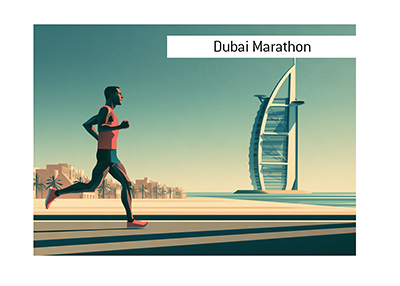
Dubai is a road marathon with separate men's and women's elite competitions. Its recent course has used the largely flat roads around Al Sufouh and Jumeirah Beach Road, passing landmarks including the Burj Al Arab and Madinat Jumeirah.
The most recently published route description includes an opening section towards Dubai Media City, followed by repeated running along Jumeirah Beach Road. It brings the runners back into the Police Academy grounds for the finish. The detailed 2027 route should be checked against the final race instructions, as some material on the course page still refers to 2026.
The layout's long, level sections suit steady pacing, but they also leave runners exposed to changing wind conditions. A group can share the work into a headwind; an athlete who breaks clear may have to absorb that effort alone.
Early starts reduce the time spent running in the warmer part of the day. They do not remove the importance of temperature, hydration or a sensible opening pace.
Dubai Marathon Records
Men: Getaneh Molla, Ethiopia - 2:03:34 in 2019.
Molla set the course record in his first marathon. His performance improved the previous mark by 26 seconds and gave Dubai its first men's winning time below 2:04.
Women: Tigist Ketema, Ethiopia - 2:16:07 in 2024.
Ketema also set her record on debut, moving up from a background in middle-distance running. She finished more than two minutes ahead of runner-up Ruti Aga.
These are Dubai course records, rather than world records for the marathon distance. They provide a useful measure of what the event can produce when the field, pacing and conditions come together.
Gebrselassie's three consecutive wins remain another notable part of the race's history. Dubai has rewarded both established champions and athletes making their first attempt at the distance.
Recent Dubai Marathon Winners
2026
Men: Nibret Melak, Ethiopia - 2:04:00.
Women: Anchinalu Dessie, Ethiopia - 2:18:31.
2025
Men: Bute Gemechu, Ethiopia - 2:04:51.
Women: Bedatu Hirpa, Ethiopia - 2:18:27.
2024
Men: Addisu Gobena, Ethiopia - 2:05:01.
Women: Tigist Ketema, Ethiopia - 2:16:07.
All six titles across these three editions went to Ethiopian runners. The men's winners were all making their marathon debuts, while the women's races included both a course record and close late battles for first place.
What Happened in the 2026 Dubai Marathon?
The February 1 race produced a clear men's winner and a much tighter women's finish.
Melak won in 2:04:00, leaving Yasin Haji 1 minute and 52 seconds behind in second. John Hakizimana finished third in 2:06:04, setting a Rwandan record. Melak's time was just 26 seconds outside Molla's course record.
The women's race changed near the finish. Muliye Dekebo had established a lead but developed stomach problems in the closing kilometres. Dessie caught her around 40km and went on to win in 2:18:31.
Dekebo held second in 2:18:43, with Fantu Worku third in 2:19:08. Dessie's winning margin was 12 seconds, and her time improved her previous best by almost four minutes.
It was Dessie's third victory from three marathon starts, following wins in Seville and Beijing in 2025. For Melak, Dubai was the beginning of his marathon record, extending the event's unusual run of debut winners.
Dubai Marathon Betting Markets
Betting coverage depends on the sportsbook and the elite fields. The men's and women's races are separate markets, and specialist options may not be offered by every operator.
Race winner: Select the athlete who will win the specified race. A familiar name is only part of the assessment, particularly at an event where newcomers have repeatedly beaten more experienced marathon runners.
Top-three or finishing position: Where available, back a runner to finish within the stated positions. The exact range matters when comparing a podium market with a broader finishing-position bet.
Head-to-head: Choose which of two named runners will finish ahead of the other. Check how the market treats withdrawals and athletes who start but do not finish.
Winning time: If offered, predict whether the winner will run faster or slower than a specified time. A tactical contest can produce a different result from a race paced aggressively from the start.
Each-way: Where supported, split the stake between a win bet and a place bet. The number of paid places and the fraction of the win odds used for the place portion vary by sportsbook.
What to Consider Before the Race
Start with the confirmed field and recent performances. For debutants, half-marathon results and other road races offer evidence of speed, but they cannot fully show how an athlete will cope with the final 10km of a marathon.
Dubai's history makes that distinction useful. A runner without a marathon personal best is not automatically an outsider, while an established fast time does not guarantee that the athlete arrives in the same form.
Consider the intended early pace alongside the weather forecast. A halfway split aimed at a course record can separate the field quickly, but it can also leave the leaders vulnerable later if the effort proves too ambitious.
The 2026 women's race is a reminder that the outcome can remain unsettled deep into the closing kilometres. Assessing who can sustain the pace matters more than simply identifying who is likely to lead early.